

AI skeptics often argue that current AI systems shouldn’t be so human-like. The idea — most recently expressed in this opinion piece by Nathan Beacom — is that…
Artificial
An LLM is a computer program. We should talk about it like a computer program.

The Persona Selection Model: Why AI Assistants might Behave like Humans
What sort of thing is a modern AI assistant? One perspective holds that they are shallow, rigid systems that narrowly pattern-match user inputs to training data. Another perspective regards AI systems as alien creatures with learned goals, behaviors, and patterns of thought that are fundamentally inscrutable to us. A third option is to anthropomorphize AIs and regard them as something like a digital human. Developing good mental models for AI systems is important for predicting and controlling their behaviors. If our goal is to make AI assistants that are useful and aligned with human values, the right approach will differ quite a bit if we are dealing with inflexible computer programs, aliens, or digital humans.
We Don't Understand Neural Networks At The Algorithmic Level
The largest ongoing debate about AI is “Are Large Language Models (LLMs) intelligent?” That makes sense, at least: the evidence is ambiguous and the stakes a...
Import AI 446: Nuclear LLMs; China's big AI benchmark; measurement and AI policy
Will AIs be jealous of one another?

The AI Industry Has a Major Problem: Most People Aren’t Freaks Who Want an AI Agent Running Their Whole Life
There's a problem for AI agents like Meta's Muse: ordinary people don't seem very interested in what they're offering.

Xuhui Zhou on Twitter / X
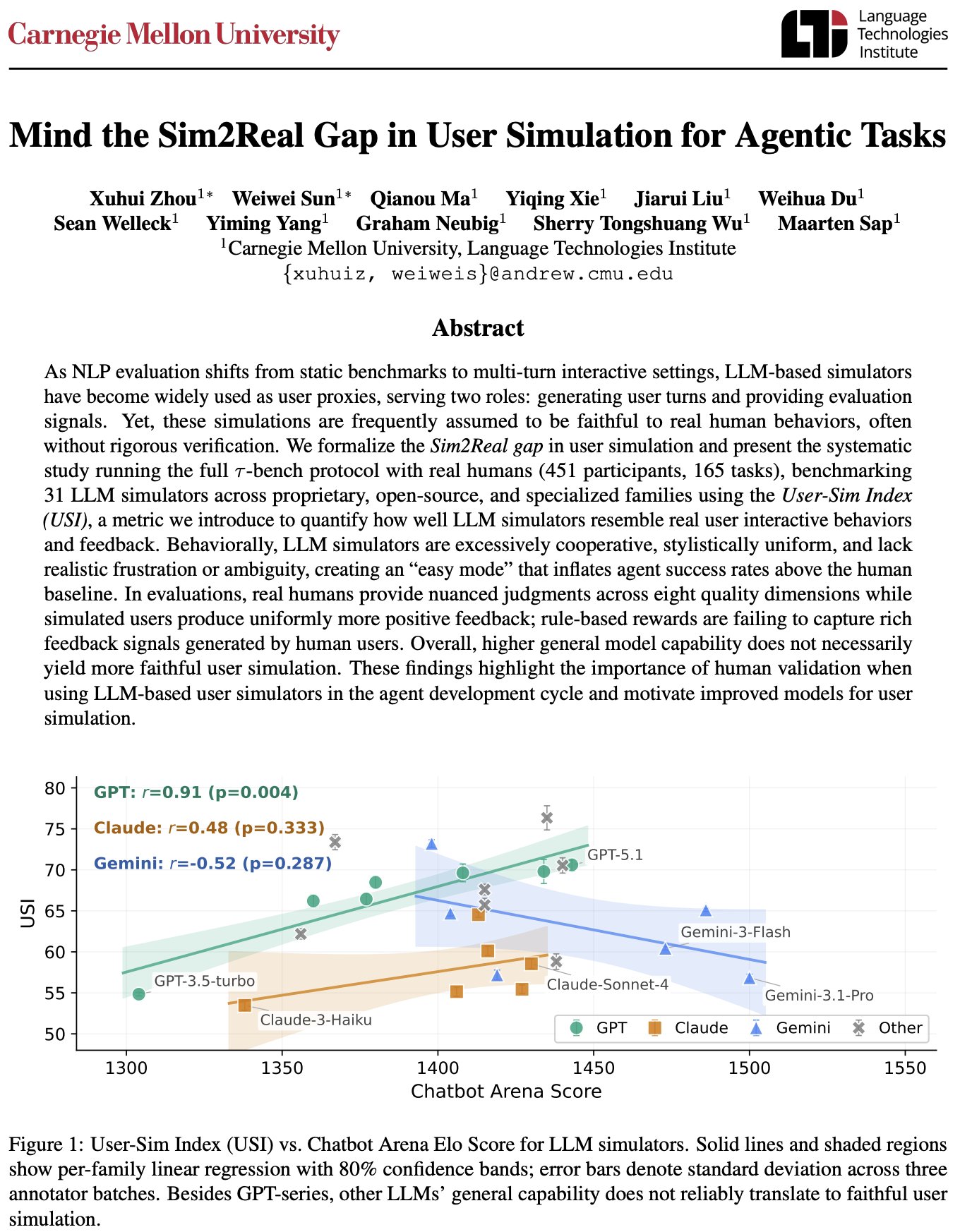
Creating user simulators is a key to evaluating and training models for user-facing agentic applications. But are stronger LLMs better user simulators?TL;DR: not really.We ran the largest sim2real study for AI agents to date: 31 LLM simulators vs. 451 real humans across 165… pic.twitter.com/SkswSzeBrz— Xuhui Zhou (@nlpxuhui) March 19, 2026
Mark Zuckerberg's AI manifesto is exactly why people don't like AI | TechCrunch
On Monday, Mark Zuckerberg published a 6,500-word manifesto about personal AI, largely about the possibilities for the "personal superintelligence" systems Meta AI is building.

Women Who Use AI Seen As Incompetent; Men Who Use AI Seen As Pragmatic
A 2026 study found that when women and men use AI tools to create identical resumes, evaluators view the women as less competent, while crediting the men with initiative.

What Happens, Exactly, When a Person Talks to an LLM?
A phenomenology of thinking with a model.

Andrew Ng: The Biggest Opportunities in AI Aren't Where You Think
If LLMs Have Human-Like Attributes, Then So Does Age of Empires II
Much research has been carried out on large language models (LLMs) and LLM-powered agentic workflows. However, many works within the field state emergence of, ascribe to, or assume, generalised anthropomorphic attributes to them (e.g., morality or understanding of natural language). Our goal is not to argue in favour or against the existence of these attributes, but to point out that these conclusions could be incorrect. For this we build and train a simple neural network on the videogame Age of Empires II, and note that any entity in a sufficiently-powerful substrate, such as LEGO or the Greater Boston Area, could also present such attributes. Hence, the purported anthropomorphic attributes of LLMs are empirically non-unique: although some properties (e.g., responses to prompts) could remain constant, others, such as the interpretation of their perceived behaviour, might change with the substrate. Thus, any empirically-grounded discussion requires explicit measurement criteria; otherwise the interpretation is left to the representation. We then show that assuming that these attributes exist or not in a system, independent of the substrate and in a generalised way, leads to either circular or uninformative conclusions, regardless of the experimenter's viewpoint on the subject. Finally we propose a 'null' assumption, where one assumes LLM non-uniqueness instead of assuming anthropomorphic attributes to set up an experiment, along with examples of it. We also discuss potential objections to our work, briefly survey the field, and prove that Age of Empires II is functionally- and Turing-complete.

Why AI hasn’t replaced software engineers, and won’t
Coding agents as normal technology

Guardian Angels: LLM Personalization for Productivity and Security
I propose an approach for highly personalized LLMs, for near-future productivity gains and personal info/cybersecurity against increasingly powerful LLMs: they should, in the spirit of uploading, try to emulate the user’s values and preferences in order to amplify the principal—not replace them. I discuss a package of techniques and proposals to accomplish such ‘guardian angels’; dynamic evaluation of LLMs combined with active learning and elicitation and heavy inner-monologue search/data-augmentation.

LLM-generated skills work, if you generate them afterwards
LLM “skills” are a short explanatory prompt for a particular task, typically bundled with helper scripts. A recent paper showed that while skills are useful to LLMs, LLM-authored skills are not. From the abstract:

More Than a Tool
What We Learned from a Year of Conversations About AI
