


Zurich has created a technology ecosystem nearing the density of Silicon Valley.
A Real Political Economy of Technology - The Ideas Letter
Two technological futures are competing for political and material priority: generative AI and the green transition. Benanav argues that while AI is marketed as a world-reordering breakthrough, its productivity gains…

Are We Really Engineers?
This is part one of the Crossover Project. Part two is here and part three is here. A conference talk based on this work is now available here. I sat in front of Mat, idly chatting about tech and cuisine. Before now, I had known him mostly for his cooking pictures on Twitter, the kind that made me envious of suburbanites and their 75,000 BTU woks. But now he was the test subject for my new project, to see if it was going to be fruitful or a waste of time.
How creatives and devs can all finally escape the control of the silicon valley of evil and make a trillion dollars · Multi-hyphenate
ft. ATprotocol (the remix)
Enshittification, Despotification, and the Open Internet
It’s not about whether technology is inherently good or bad, liberating or oppressive. Architecture shapes incentives; incentives shape outcomes.

What It's Actually Like to Build a Tech Company in Canada | Tyler Bryden
The honest version of building in Canada — the funding gap, talent reality, what's genuinely good, and what I'd tell someone starting here today.
How creatives and devs can all finally escape the control of the silicon valley of evil and make a trillion dollars - Multi-hyphenate
ft. ATprotocol (the remix)
Big Tech Pulled the Plug. They Downloaded Their Lovers.
How Chinese users created AI lovers, friends and family — and struggled to let them go

Something Big Is Happening
A personal note for non-tech friends and family on what AI is starting to change.

The Future Is Not Tech-Forward
On artificial intelligence, data centers, technological politics, and who gets to build the future.

The Future of Software Engineering Isn’t What You Think
Over the past two decades, I’ve watched software eat the world, then hardware catch up, then Generative AI reshape both at the same time…
You have to know how to drive the car
There are lots of different ways to be a software engineer. You can grind out code for twelve hours a day to make the world a better place. You can focus on glue work: process-based work that makes everyone around you more successful. You can join the conversation with your product manager and designer colleagues to influence what gets built, not just how it gets built. You can climb the ladder to staff engineer and above, or you can take it easy and focus on your hobbies. But whichever of these you choose, you have to know how tech companies work.

Relational Tech Project — Build what we need
Many of us wish our neighborhoods were more connected. We want to live in neighborhoods where we learn from the creativity, care, and skills of our neighbors — and share our gifts too.

AI, I tried to love you – Writings and rehearsals by Nathan Schneider
Among my peers who study the cultures and economies surrounding technology, I often find myself more tech-positive than most. On the whole I like computers, like the internet, and like in general the emergent human creativity that these things have enabled and revealed. A source of my appreciation is that I expend a lot of effort on the practice of “slow computing,” which is to say, choosing tools and technical communities that I can feel in right relationship with. I tend to approach new socio-technologies (like gig economies, blockchains, and social media) not from a perspective of why is this so bad? so much as asking how could we do this right?

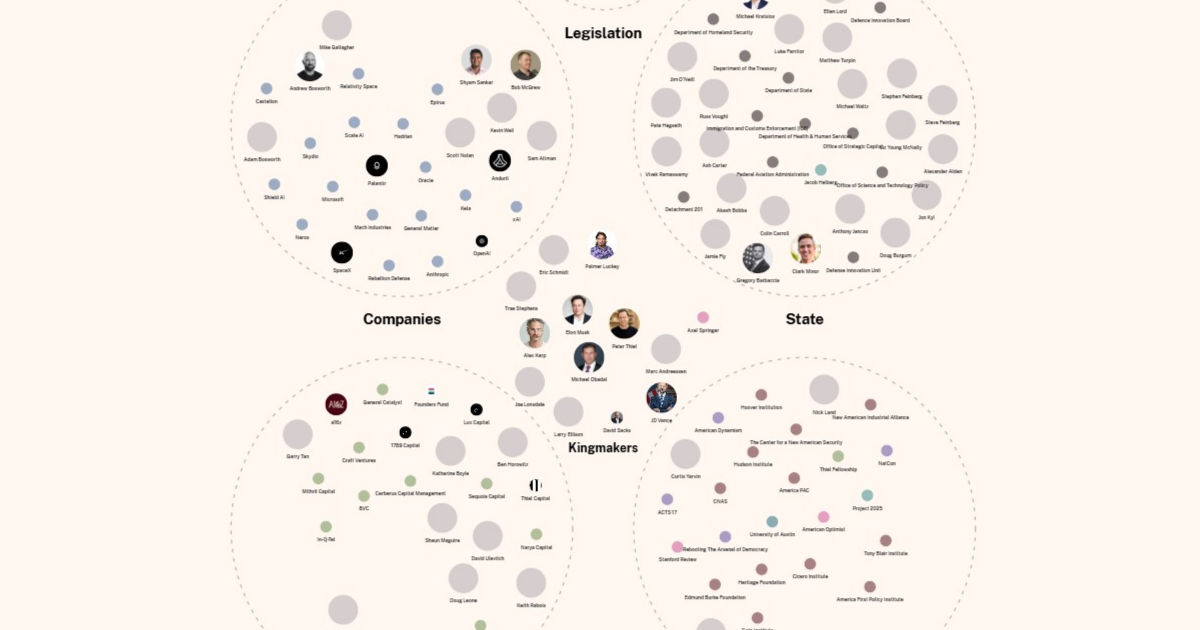
The Authoritarian Stack
How Tech Billionaires Are Building a Post-Democratic America — And Why Europe Is Next
How Dependent Is Your Newsroom on Big Tech?
A web-based survey tool that evaluates journalism organizations' dependency on Big Tech platforms and services.
