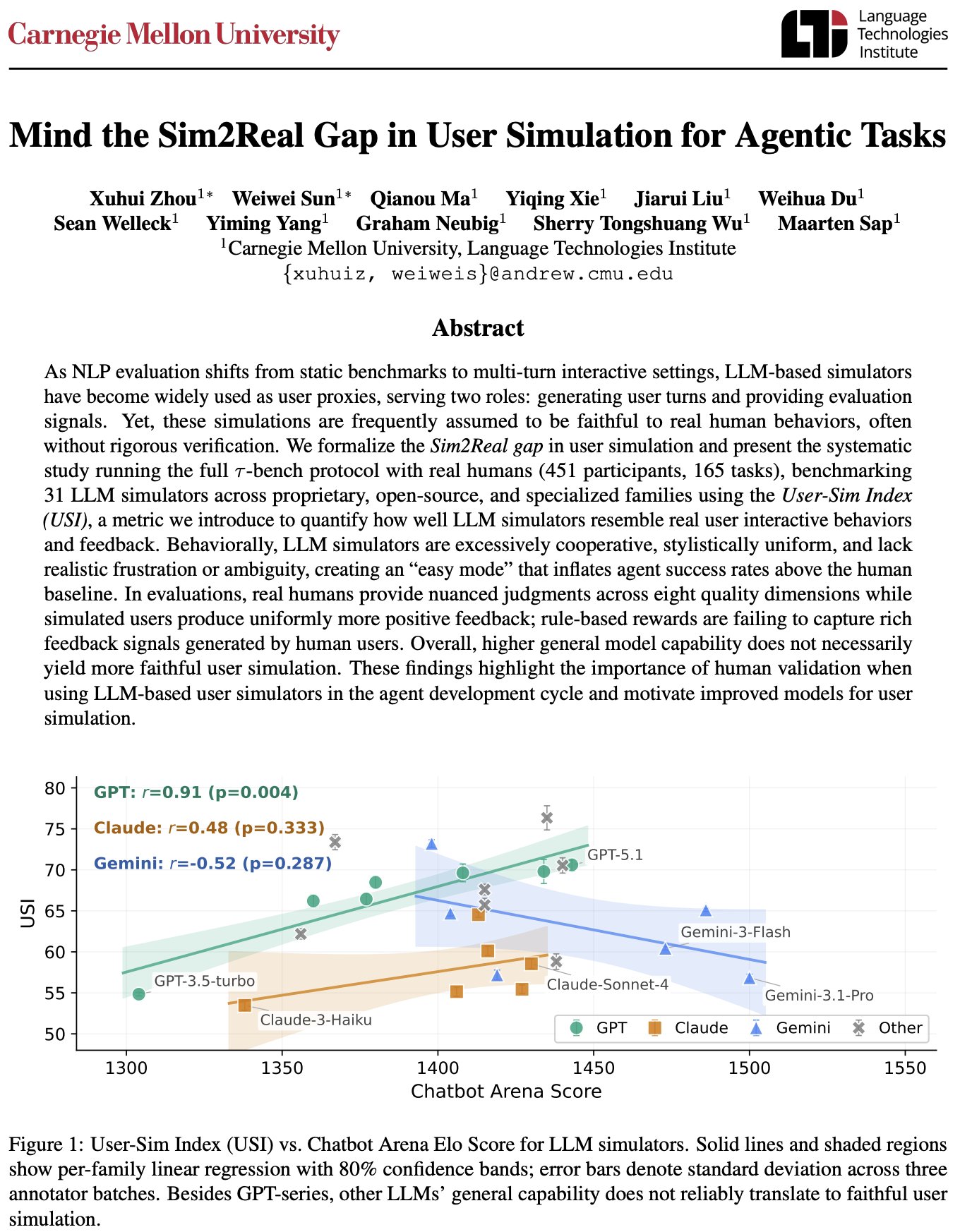
Creating user simulators is a key to evaluating and training models for user-facing agentic applications. But are stronger LLMs better user simulators?TL;DR: not really.We ran the largest sim2real study for AI agents to date: 31 LLM simulators vs. 451 real humans across 165… pic.twitter.com/SkswSzeBrz— Xuhui Zhou (@nlpxuhui) March 19, 2026
Giving LLMs a personality is just good engineering
AI skeptics often argue that current AI systems shouldn’t be so human-like. The idea - most recently expressed in this opinion piece by Nathan Beacom - is that language models should explicitly be tools, like calculators or search engines. Although they can pretend to be people, they shouldn’t, because it encourages users to overestimate AI capabilities and (at worst) slip into AI psychosis. Here’s a representative paragraph from the piece:

LLM-Augmented Agent-Based Simulation of Cyber Social Agents
Social media bots are often portrayed as malicious automations to be detected and removed, but automation on social media platforms encompasses a wide spectrum of roles, behaviors, and rhetorical strategies that can shape online discourse in both constructive and destructive ways. This work conceptualizes these automated actors as \textbf{Cyber Social Agents} through a taxonomy of archetypes characterized by their operational tactics and rhetorical style. We integrate this taxonomy into an LLM-driven social simulation, where agents communicate and coordinate in a network environment. Using empirically grounded CSA personas, we simulate heterogeneous online societies to study how agent diversity shapes information diffusion and social influence. Our approach bridges the gap between rule-based agent models and LLM-powered simulations with generated agents that are parameterized from empirical data.
crawshaw - 2026-02-08
I wrote up my experiences programming with LLMs a bit over a year ago, and updated it for the world of agents eight months ago. A lot has changed since then, so here is an update.
Artificial
An LLM is a computer program. We should talk about it like a computer program.

Track, control, and optimize for AI agents and bots | Known Agents (formerly Dark Visitors)
Use Known Agents to turn the rising wave of AI agents, LLM assistants, and other bots crawling your website into a new growth channel for your business

Build agents, not pipelines
There are only two ways to use LLMs in a computer program: as part of a pipeline, or as an agent. In other words, either you express the control flow of the program in code, or you give a LLM tools and allow it to manage the control flow itself1.
Introducing Persimmon | humans&
A model of human behavior, and new ways to measure how faithfully AI can simulate people.

Import AI 446: Nuclear LLMs; China's big AI benchmark; measurement and AI policy
Will AIs be jealous of one another?

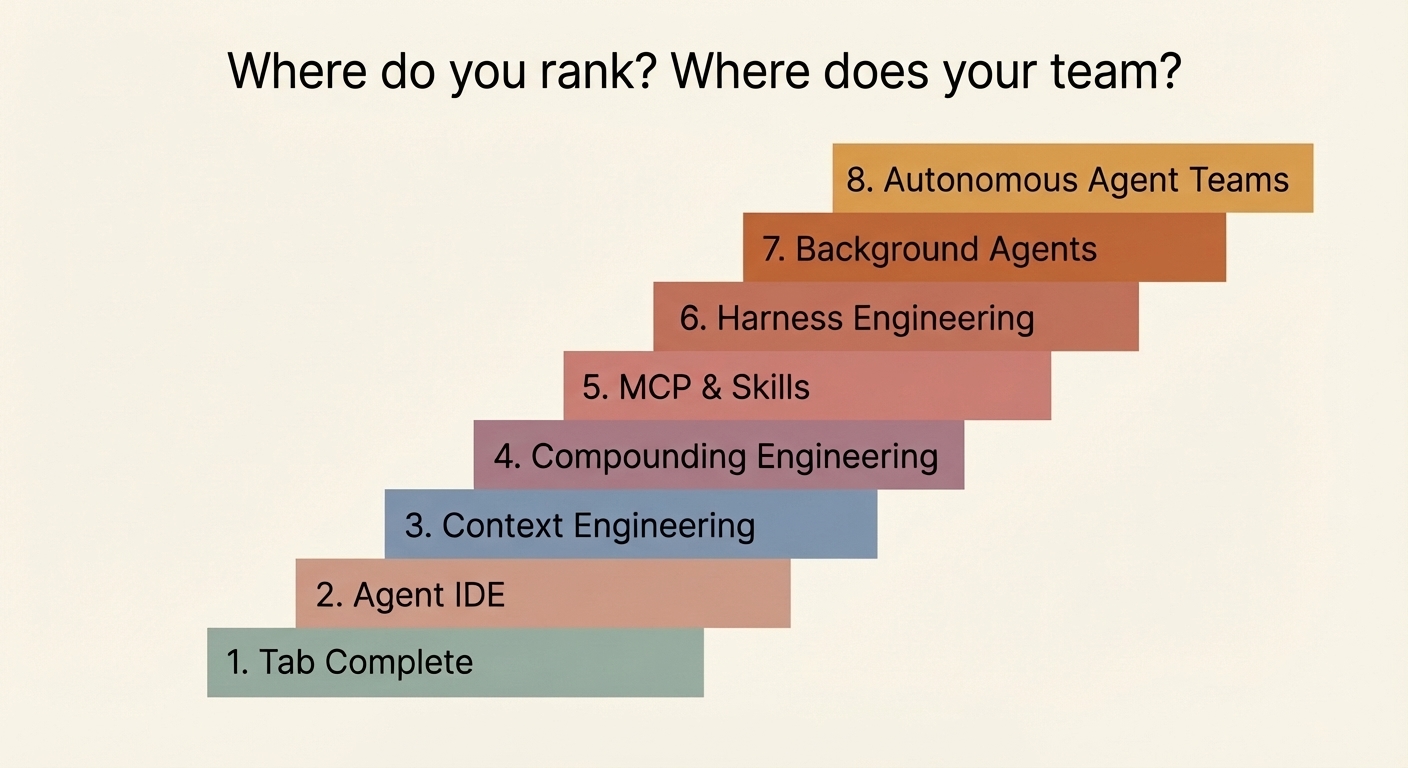
The 8 Levels of Agentic Engineering — Bassim Eledath
AI's coding ability is outpacing our ability to wield it effectively. That gap closes in levels — 8 of them. Here's the progression from tab complete to autonomous agent teams.
IO Factory: Simulating AI-Enabled Influence Campaigns at Scale
We introduce IO Factory, an AI-driven framework for simulating information and influence campaigns as fully integrated, traceable processes. The threat of digital manipulation now extends beyond persuasive text from individual language models to AI swarms, i.e., persistent groups of coordinated agents that adapt to platform feedback and disguise organized campaigns as ordinary social interaction. Because such campaigns cannot be identified from isolated messages alone, they must be analyzed across a continuous spectrum of planning, platform action, exposure, interpretation, measurement, and adaptation. IO Factory represents this process inside a controlled simulated platform, linking actor roles, platform actions, exposure records, structured model-based evaluations, and configured changes in the simulated population. We implement the architecture and evaluate it across configurations of up to 100,000 agents. The results show that IO Factory executes campaign timelines at scale and produces inspectable evidence of exposure and measured movement in configured belief variables. By recording the actors, objectives, action constraints, exposure paths, and measurement rules used in each run, IO Factory supports reproducible research and red-team analysis of coordinated influence.

What the AI Wizard taught us about LLM code generation at scale - PostHog
You know what’s boring? Writing integrations. It’s a task you’ll do once, but you always need to do it right, which means carefully reading docs…
The Eternal Sloptember
I’m calling it now, the adoption of AI agents into software development will be one of the most costly mistakes in the field’s history. Agents cannot program, and it’s taking longer and longer to realize that they can’t. They are a highly sophisticated statistical model designed to mimic the distribution of programming. The output is broken, but in a way that’s getting harder and harder to detect. Which is exactly what you’d expect from an increasingly accurate statistical model.
How StrongDM’s AI team build serious software without even looking at the code
Last week I hinted at a demo I had seen from a team implementing what Dan Shapiro called the Dark Factory level of AI adoption, where no human even looks …
AIs can’t stop recommending nuclear strikes in war game simulations
Leading AIs from OpenAI, Anthropic and Google opted to use nuclear weapons in simulated war games in 95 per cent of cases

The Persona Selection Model: Why AI Assistants might Behave like Humans
What sort of thing is a modern AI assistant? One perspective holds that they are shallow, rigid systems that narrowly pattern-match user inputs to training data. Another perspective regards AI systems as alien creatures with learned goals, behaviors, and patterns of thought that are fundamentally inscrutable to us. A third option is to anthropomorphize AIs and regard them as something like a digital human. Developing good mental models for AI systems is important for predicting and controlling their behaviors. If our goal is to make AI assistants that are useful and aligned with human values, the right approach will differ quite a bit if we are dealing with inflexible computer programs, aliens, or digital humans.
RSI Simulator: Play the Economics of Recursive Self-Improvement
Bootstrap an AI lab from scratch. A web game from Paradigm built on real economic models of AI recursive self-improvement.