End-to-end encrypted IPv6 networking to connect worlds
CryptPad: end-to-end encrypted collaboration suite
CryptPad: end-to-end encrypted collaboration suite
CryptPad: end-to-end encrypted collaboration suite
CryptPad: end-to-end encrypted collaboration suite
End-to-end encrypted relays for OCapN — Spritely Institute
Creating a direct connection between any two computers (not just from client to server) over the internet is notoriously difficult. Many home networks are behind NATs which prevent new inbound connections. Sometimes these NATs are from the ISP (carrier-grade NATs) which are impossible to work around with port forwarding and/or UPnP. While hole punching techniques can break through NATs, it's far from guaranteed. Thus, we need something that works in the general case: relays.
Architecture
Overview of Ente's end-to-end encrypted architecture—learn how your data is encrypted on-device, securely shared, and safely stored using cryptography.

TIL: Iroh: peer-to-peer networking for app developers
I came across Iroh (via, via) today as it hit 1.0 and found it a really interesting solution to a problem I knew existed but had not thought a lot about. Judging from the comment sections, it seems pretty clear that lots of people are confused as to exactly what Iroh is. I don’t think their launch post does their product justice at all, and their tagline is “IP addresses break, dial keys instead” which sounds cool, but if you think about it for just a second, you’ll end up with lots of questions. The biggest one is: “so how is this different from a mesh VPN like Tailscale, ZeroTier, Netbird, etc.?” It’s only after reading a lot of developers’ comments on the threads that I feel I understand: Iroh is aimed at application developers who want to communicate P2P between machines running their app, while mesh networks are aimed at network admins who want to connect devices they own/manage together.
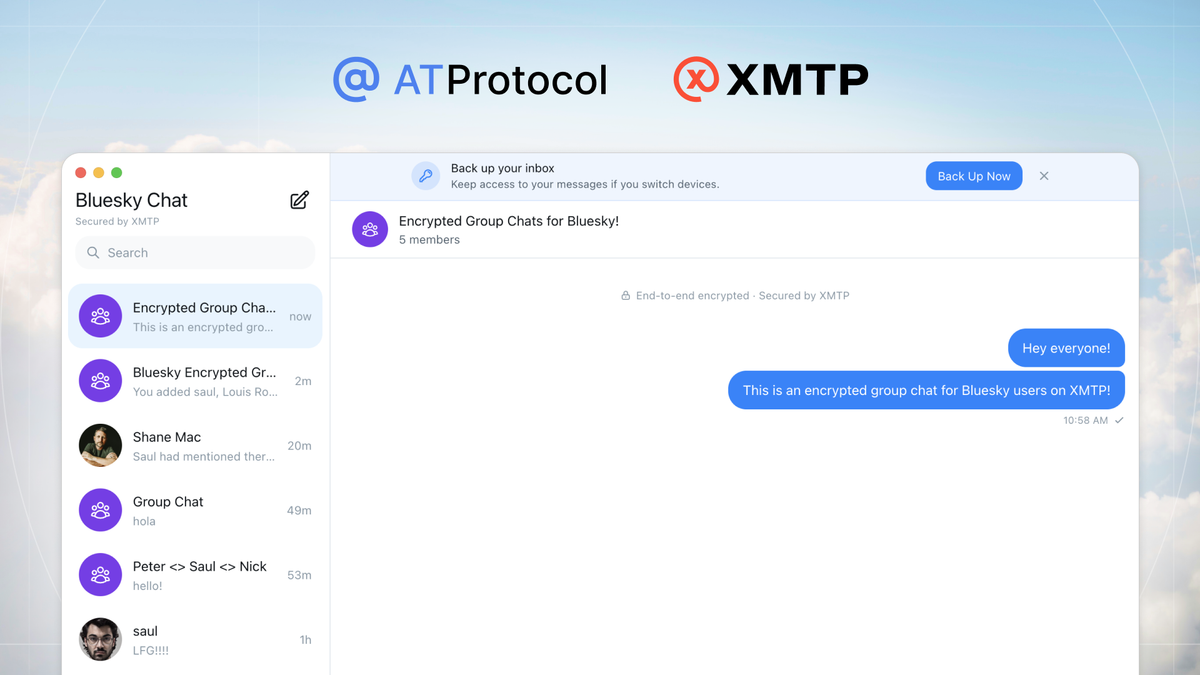
Unlocking Quantum-Encrypted Group Chats for ATProto on XMTP
Developers building with ATProto (the protocol powering Bluesky) have been asking how they can use XMTP to power messaging between users in their apps. It’s possible today to add secure messaging to any Bluesky app, and to add Bluesky identity to any messenger built on XMTP. 0:00 /0:
primus852/traefik-ddns
This repository provides configuration files and instructions for setting up a Cloudflare Dynamic DNS (DDNS) service and a Traefik reverse proxy with Let's Encrypt SSL/TLS support. It includes Docker Compose configurations, environment variable templates, and detailed usage instructions to automate DNS updates and manage SSL certificates.
Encrypted Spaces — Research preview
An architecture for collaborative applications where data is encrypted and operations are cryptographically verifiable.

ATSMS — end-to-end encrypted group messaging
Encrypted group messaging on AT Protocol identities, with no server ordering anything.
Is End-to-End Encryption Optional For Large Groups? - Dhole Moments
One of the recent topics in Messaging App Discourse is whether it makes sense to prioritize End-to-End Encryption (E2EE) when searching for an alternative to Discord. Who’s Saying “No&#…

Cryptomator - Free & Open-Source Cloud Storage Encryption
Cryptomator is an open-source encryption tool for secure cloud storage. Protect your privacy for free on Dropbox, Google Drive, OneDrive, and more.
Tailscale’d Into Homelabbing
Having my own homelab was something I wanted to try for a long time. However, I just couldn’t get started. Mostly because I kept overthinking it. How will I handle dynamic IPs? Do I need something like a local DNS on my router for that? Even if I solve things inside the home, how am I supposed to access it remotely? Do I need port forwarding at the NAT layer? And what about TLS certificates, how do I even manage those without using a public certificate authority?

Deep dive into iroh: A replacement for WireGuard or a P2P layer for your application?
Just last week, the iroh project announced the release of its v1.0. What is iroh? Well, I'm glad you're asking because it's a very interesting project that I'm following for

Secure Scuttlebutt Consortium
A distributed and secure peer to peer social network - Secure Scuttlebutt Consortium

Migrate to Northsky!
Your data will be hosted securely on our servers and your experience will be improved by our moderation team and new safety features we develop.
Self-Hosted Vercel and Netlify Alternative - Stormkit
Stormkit is a self-hostable, full-featured alternative to Vercel and Netlify, offering powerful features such as deployment previews, multiple environments, and seamless integration with Git.